
MRgFUS & Neuroimaging
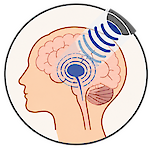 Our research group focuses primarily on how MRgFUS (Magnetic Resonance-Guided Focused Ultrasound) thalamotomy alters functional and structural brain networks in patients with movement disorders, such as essential tremor (ET) and tremor-dominant Parkinson's disease (TD-PD).
Theme 1: Effects of MRgFUS on tremor networks
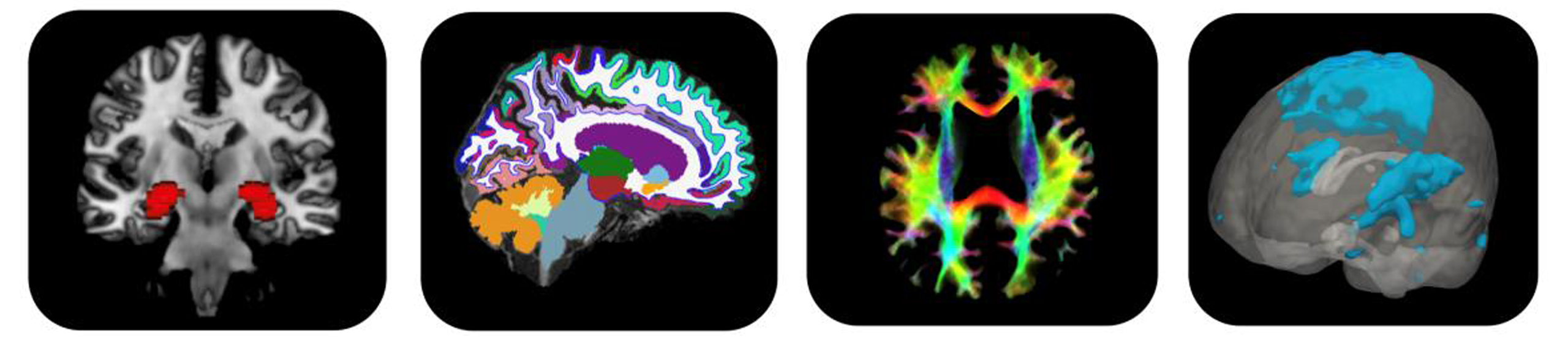
Our group investigates the multimodal impact of MRgFUS thalamotomy targeting the dentato-thalamo-cortical tract (DTCT) in ET patients. Using probabilistic tractography and task-evoked fMRI, we found that therapeutic thalamic sonication induces highly localized structural changes within the DTCT. This anatomical disruption downregulates pathological over-activation, significantly reducing excitatory motor input to the contralateral sensorimotor cortex and ipsilateral cerebellar lobules. Ultimately, this work provides direct evidence that clinical tremor reduction is achieved by micro-structurally severing the hyperactive cerebello-thalamo-cortical tremor loop (PMID 35735240). Longitudinal macroscopic and microscopic structural studies following MRgFUS for ET demonstrate that VIM lesions extend beyond the immediate tremor network. At the macroscopic level, these lesions alter gray matter volume across remote brain regions (PMID: 39913957), while microscopic assessments show long-term microstructural reorganization and changes in diffusivity distal to the lesion along the DTCT (PMID: 40651055). Furthermore, resting-state fMRI reveals broad functional connectivity changes in the visual and frontoparietal networks, in addition to expected sensorimotor and cerebellar alterations (PMID: 37717502). Collectively, these findings suggest that MRgFUS induces widespread structural and functional neuroplastic adaptations across the entire brain.
Theme 2: Connectomics and Macroscale Brain Network Plasticity
This body of work shifts the mechanistic understanding of MRgFUS from a simple local ablation to a catalyst for widespread, systemic neuroplasticity. The research utilizes fMRI and advanced computational frameworks (Graph theory metrics (small-worldness, global efficiency, clustering coefficients), transfer entropy, whole-brain ignition modeling, and resting-state functional connectivity (FC)) to track how structural lesions alter global functional brain states. Successful thalamic ablation (specifically targeting the VIM) induces a macroscopic topological network reorganization (PMID: 42710366; PMID: 41764014). Clinical recovery from tremor correlates directly with increased global network efficiency, a shift toward highly integrated network architecture, and the restoration of normalized information flow across extended motor hubs (PMID: 37230462).
Theme 3: Stereotactic Target Mapping
This line of research focuses on imaging-based optimization to enhance the safety margin and efficacy of neurosurgical planning. By evaluating structural outcomes across cohorts, this research maps precise anatomical "sweetspots" within the thalamus for treating ET and TD-PD. The data demonstrate a critical spatial threshold: even millimeter-level deviations from these probabilistic coordinates significantly elevate the overlap with surrounding tracts, driving transient post-operative adverse effects like paresthesia, dyskinesia, or gait instability (PMID: 40778498).