

Outpatient unit for motoneuron disease
Our outpatient clinic is the contact point for patients with amyotrophic lateral sclerosis (ALS), spinal muscular atrophy (SMA), Kennedy's disease (SBMA) and other motor neuron diseases at the University Hospital Bonn.
Diagnosis, treatment and research of these diseases are the focus of our efforts. We also offer a second opinion and genetic counseling.
Our aim is to clarify the cause of the symptoms at an early stage so as not to delay the initiation of appropriate treatment.
Our treatment includes a
- clinical-neurological examination
- Nursing care and aids advice
- psychological support
- genetic counseling
- Offer to participate in research projects, observational and treatment studies
Depending on the symptoms, further examinations are carried out on an outpatient basis or in a short inpatient stay:
- examinations of blood and cerebrospinal fluid ("cerebrospinal fluid")
- cerebral and spinal imaging
- Electrophysiological diagnostics (neurography, electromyography, multimodal evoked potentials, EEG, ultrasound diagnostics).
- Swallowing examination (including FEES)
We cooperate closely with:
- Department of Neurology (with neurological sleep laboratory)
- Center for Rare Diseases
- Institute for Human Genetics
- Clinic for Palliative Medicine
- Center for Internal Medicine (Section Gastroenterology and Section Pulmonology)
Please bring the following documents to your first appointment:
- referral slip (from your family doctor or specialist), referral slip if necessary)
- Insurance card, if applicable
- Medication list (current and previously taken medication)
- preliminary medical findings can be faxed in advance (+49 228 287 90 31310)
- if available, imaging (MRT or CT) on CD-ROM with radiological findings
Useful links:
ALS-All Loving Schmidt e.V. (self-help association)
Dt. German Society for Muscular Diseases (DGM)
Ambulance Partners
German Network for motor neuron diseases
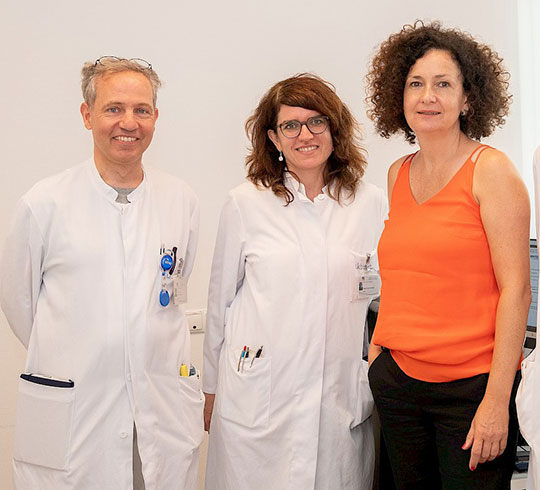
Team unit for motoneuron disease
Office Hours
PD. Dr. med. Patrick Weydt
Tue - Thu 9 am - 4 pm and on appointment
Appointment
Fax: +49 228 287-9031310
Latest information videos
Interview with PD Dr. Weydt about ALS
Statement from PD Dr. Weydt on AMX0035
Patient information video PEG
Patient information video NIV
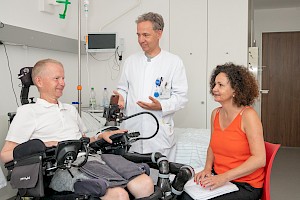 Mobility is an important aspect of quality of life. In the case of ALS, mobility can be affected to varying degrees of severity and extent. Muscular atrophy and stiffness lead to progressive limitations. This can affect the legs with corresponding difficulties to move, or the arms and hands with problems to hold something or a disturbed fine motor skills when opening a bottle.
The restrictions in mobility can be significantly improved by a complication-free, rapid prescription of specific aids.
We would be happy to advise you on this from us or our specialist center.
In ALS, speech disorders (dysarthria) can occur at the beginning and up to 70% in the further course of the disease. This can mean a slight blurred speech up to the point where articulation is disturbed in such a way that no understandable words come out at all. The disturbed speech can lead to social withdrawal and loneliness and thus also considerably reduce the quality of life. There are various communication aids for patients with speech disorders that help them to actively participate in conversations again.
We will be happy to advise you on this.
In addition to speech disorders and restrictions of the tongue motor function, the muscles responsible for chewing and swallowing can be affected. Initially, it can only be a matter of aggravated food intake, which is made easier by changing the diet.
However, the swallowing disorder and the associated weight loss, as well as the increased risk of pneumonia due to partly unnoticed swallowing (so-called aspiration pneumonia), is a loss of function that not only reduces the quality of life but can also become a direct life-limiting factor.
A detailed diagnosis regarding a swallowing disorder can reveal problems already in the early stages (FEES=flexible endoscopic evaluation of swallowing). A consultation for a special diet or nutritional aids are essential in addition to regular logopedic co-care to avoid the undesired weight loss. The creation of a PEG (percutaneous gastrostomy) should also be considered early on as an additional aid.
The diaphragm or diaphragm can also be affected by ALS as a muscle, as can the respiratory muscles. This is shown by a limited ability to cope with stress, shortness of breath when walking or even headaches and daytime tiredness due to non-recuperative sleep.
There are different ways to support the respiratory muscles. Depending on the progression of the disease, different respiratory aids can be used, such as mask respiration, a so-called non-invasive respiration, which can only be used at night or intermittently during the day if necessary.
Patient report on non-invasive ventilation (NIV)
On the other hand, there is invasive ventilation, which can establish a permanent and safe supply of respiration by means of a surgical intervention (tracheotomy/"tracheotomy").
Respiratory support measures (invasive and non-invasive) in combination with nutritional aids can achieve an extension of the life span by months up to several years, depending on the selected procedures and the individual course of the disease.
Excessive salivation
Due to the weakness of the chewing and pharyngeal musculature culture, a reduced swallowing frequency or insufficient swallowing may occur. As a result, saliva accumulates in the mouth and instead of being swallowed down, a possibly very impairing leakage of saliva from the mouth occurs, the so-called pseudohypersalivation.
There are various drug approaches to reduce this. In addition to taking medication, botulinum toxin injections into the salivary glands can also significantly reduce salivary flow. The effect lasts for about 3 months and can then be repeated. The advantage is that a sustained reduction in saliva production can be achieved without the need for daily medication.
You can make an appointment for consultation or treatment here:
Cough Assist
The Cough Assist is a device that assists patients with the mobilization and removal of bronchial secretions who have problems doing so due to weakened breathing or coughing. This can occur due to weakened respiratory muscles or a general loss of strength in ALS patients. The mobilization of secretions can facilitate breathing and reduce respiratory infections.
During a short inpatient stay, a Cough Assist can be fitted in our clinic.
Muscle cramps and pain
Muscle cramps and spasticity (muscle stiffness) are often not sufficiently controlled symptoms. In our outpatient clinic we recommend treatment with medical cannabis. Cannabis has antispastic, sleep-regulating and pain-relieving effects and has also been shown to have a beneficial effect on the course of ALS. In case of efficacy and good tolerability we support the use of cannabis products for symptom control without time limit.
Cannabis treatment at ALS-Podiumdiscussion, ALS-Tag Bonn 2020
There are considerable differences in the treatment of ALS. Due to the individual course, each patient has different needs. By offering a wide range of consultation services, we try to provide help and support for the important questions arising from the disease.
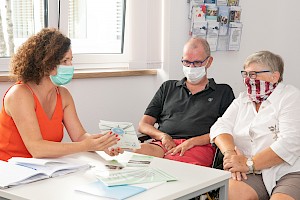
Our consulting offer includes:
- Nursing care and aids consultation
- psychological support
- genetic counseling
- Drug therapy for frequent symptoms such as muscle pain/spasms or increased salivation
- Offer to participate in research projects, observational and treatment studies
Social counseling at the University Hospital Bonn: Interview with Ms. Gasper (German)