
DFG Research Training Group Urban Future
The Research Training Group „Urban Future – managing transformations for a better health in blue cities“ examines how urban spaces along rivers and coastlines can be designed and managed to promote public health, ecological sustainability, and social justice. At its core is the concept of the „Blue City“: urban environments where water is not merely a resource or hazard, but an integral component of urban planning, infrastructure, and societal identity. The RTG bridges natural, health and economics & social sciences to decode the complex interactions between urban transformations, water-related challenges, and public health outcomes.
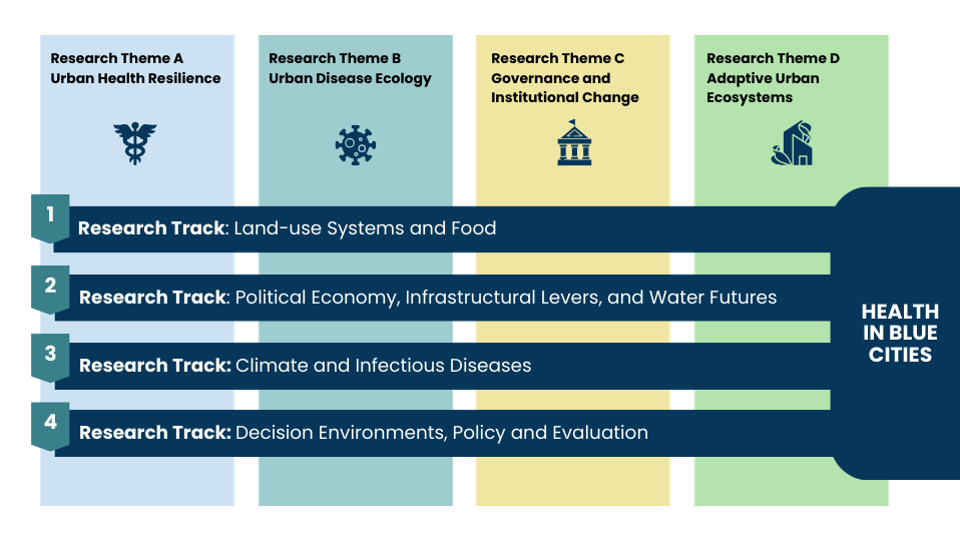
The RTG is operated by the University of Bonn and the Bonn-Rhein-Sieg University of Applied Sciences in cooperation with German Institute of Development and Sustainability (IDOS) and various partner universities in Africa, Asia and Latin America. The heart of the RTG is the structured, interdisciplinary training program that places strong emphasis on developing systems thinking, transdisciplinary research, and the development of meta-competencies required for the interdisciplinary research of complex urban systems. Four research clusters (Urban Health Resilience, Urban Disease Ecology, Governance and Institutional Change, Adaptive Urban Ecosystems) form the conceptual foundation, operationally linked through four interdisciplinary research tracks.
Description
This cluster investigates how urban communities in Blue Cities cope with, adapt to, and build resilience against water-related health stressors such as flooding, drought, heat islands, air pollution, and unequal access to clean water. It focuses on social determinants of health, vulnerable populations, and the role of ecosystem services of green-blue infrastructure, participatory planning, and community-based health initiatives. The cluster integrates epidemiological, sociological, environmental and urban planning perspectives to develop strategies that link health protection with social equity and urban adaptation capacity.
Example PhD Topics and corresponding methods:
- Urban Food Systems
- Nutritional analysis, dietary surveys, health outcome measurements, intervention studies
- Soil Health and Soil Functions
- Soil surveys to quantify soil health indicators, Ecosystem & Functional Measurements
- One Health & Planetary Health Resilience
- Human (mental) health assessments, environmental exposure measurements, longitudinal studies, spatial analysis, socio-ecological analysis, intervention/transformative studies
- Urban Blue and Green Infrastructure
- Health impact assessment, Human (mental) health assessments, environmental exposure measurements, KAP surveys, perception surveys, spatial analysis, ecosystem services accounting
Supervisors:
Prof. Dr. Ina Danquah; PD Dr. Timo Falkenberg; Prof. Dr. Martin Hamer; Prof. Wiltrud Terlau; Prof. Dr. Mariele Evers
Description
Urban Disease Ecology explores the ecological and environmental drivers of disease in urban water landscapes. It focuses on water- and vector-borne infectious diseases, climate-induced health risks, and the interplay between urban morphology, water quality, and human health. The cluster applies One Health approaches to understand how changes in land use, water management, and urban density influence pathogen transmission. Research aims to develop predictive models, monitoring systems, and prevention strategies specifically tailored to the dynamics of Blue Cities.
Example PhD Topics and corresponding methods:
- Antimicrobial Resistance
- Microbiological sampling, cultural and molecular analyses, resistance profiling, surveys, water quality analysis, transmission and impact modelling
- Helminth Infections and NCDs
- Parasitological, microbiological and immunological analysis, clinical examinations, biomarker analysis, mouse model for mechanistic insight
- Urban Microbiome & Dietary Ecology
- Microbiome sequencing, dietary pattern analysis, meta-genomic analysis, computational analysis
- Vector-Borne Disease
- Climate monitoring, entomological surveys, temperature mapping, vector modelling, pathogen detection
Supervisors:
Prof. Dr. Christian Borgemeister; Prof. Dr. Achim Hörauf; Prof. Dr. Marc Hübner; Dr. Indulekha Karunakaran; Prof. Dr. Nico Mutters; PD Dr. Marijo Parcina; Dr. Manuel Ritter; Prof. Dr. Marie-Christine Simon; Dr. Nicole Zacharias.
Description
This cluster analyzes how political, institutional, and societal structures enable or hinder urban transformations towards better health in Blue Cities. Considering health and environmental systems it examines the complex water-health-governance nexus, including institutional and policy instrument design, inter-sectoral-collaboration, financing mechanisms, and participatory decision-making. It also addresses the political economy of institutional and technological change, and investigates the impact of urban interventions and resulting implications for institutional design. Research investigates how governance systems can be adapted to climate change, population growth, and unequal resource distribution. The goal is to generate evidence-based recommendations for inclusive, transparent, and adaptive urban development.
Example PhD Topics and corresponding methods:
- Biodiversity-Based Bio-Economies
- Economic impact assessment, policy and value chain analysis
- Cross-Sectoral Governance
- Stakeholder mapping, policy analysis, governance framework development, case studies
- Urban Transformation & Pharmaceutical Innovation
- Case study analysis, technology assessment, policy evaluation, innovation studies
- Political Economy of Health Equity and Technological Change
- Political economy analysis, institutional economics, policy process tracing, case studies, impact analysis
- Urban Healthcare Policy Implementation
- Institutional economics, case studies, impact analysis, microeconometric evaluation
- Climate-Responsive Health Policy
- Policy and infrastructure mapping, Spatial analysis, Policy evaluation, implementation research and economic impact assessment
Supervisors:
Prof. Dr. Katja Bender; Prof. Dr. Jan Börner; Prof. Dr. Anna-Katharina Hornidge; Prof. Dr. Simona Helmsmüller; Dr. Christoph Strupat.
Description
Adaptive Urban Ecosystems focuses on the planning, management, and ecological functionality of blue-green infrastructure in urban environments. It addresses land-use systems, future water infrastructure, nature-based solutions, and the resilience of urban ecosystems to climatic and socio-economic shifts. The cluster combines engineering, ecological, and planning approaches to study how urban systems can be sustainably designed through adaptive management, circular economy principles, and integrated water resource management. Research provides the scientific basis for multifunctional Blue Cities that link ecosystem services with urban quality of life.
Example PhD Topics and corresponding methods:
- Coupling Mechanisms of Urbanization
- Hydrological modelling, System dynamic modelling, analysis of ecosystem services
- Biodiversity and Human Wellbeing
- Biodiversity surveys, spatial data analysis, socioeconomic surveys
- Urban Soil Management
- Soil sampling, soil biodiversity surveys, morphological or molecular soil organism identification, soil health indicators, spatial analysis
- Urban Decision Environments
- Coupled Ecological-Economic Systems Modelling, Collective Learning Dynamics
- One Planetary Health
- Integrated modelling, framework development, systems thinking, commons governance studies
Supervisors:
Prof. Dr. Wolfram Barfuss; Dr. Bibiana Betancur; Prof. Dr. Lisa Biber-Freudenberger; Prof. Dr. Mariele Evers.
Call for Applications
DFG-Research Training Group (RTG)
„Urban Future – managing transformations for a better health in blue cities“
10 doctoral research positions (all genders)
in the interdisciplinary field of urban health
The Research Training Group will start on 1 April 2027. Successful applicants will be offered a 4-year doctoral support contract with remuneration dependent on TV-L pay grade 13 (65%) according to the German public salary scale; employment will be either at the University of Bonn or the Bonn-Rhein-Sieg University of Applied Sciences. Degrees will be obtained from the medical, mathematical-natural science, philosophical or agricultural, nutritional and engineering sciences faculties or the Promotionskolleg NRW, respectively, depending on disciplinary background and research focus. All doctoral researchers will complete the structured doctoral program, which strongly emphasizes systems thinking and transdisciplinary approaches to build meta-competencies for urban health research. Next to overarching interdisciplinary courses, specific disciplinary courses and soft-skills training make up the foundation of the program.
The RTG „Urban Future“ investigates how urban transformations in “Blue Cities“ – urban areas situated along rivers or coastlines where water is explicitly integrated into urban planning and holds a central place in societal identity – can be managed to improve public health, social equity, and ecological sustainability. The research focuses on the complex water-health-governance nexus, with a particular emphasis on cities in the Global South as living laboratories. The RTG is a joint initiative of the University of Bonn and the Bonn-Rhein-Sieg University of Applied Sciences, in close cooperation with international partner institutions in Ghana (KNUST, UG, UCC), Togo (UOL), Cameroon (UBUEA), Brazil (USP) and Japan (UTokyo). While partner networks provide a strong international framework, applicants are free to propose research sites in any “Blue City” worldwide.
The RTG is structured around four overarching Research Themes (RTs):
A) Urban Health Resilience,
B) Urban Disease Ecology,
C) Governance and Institutional Change, and
D) Adaptive Urban Ecosystems
Your tasks:
- Actively participate in the RTG training program and interdisciplinary seminars
- Conduct independent, RT-aligned doctoral research, including method development, data collection, analysis, and publication
- Contribute to the development of Blue City concepts and transdisciplinary knowledge exchange
Your profile:
- Completed Master’s degree (or equivalent) in a relevant discipline (e.g., Agricultural and Food Systems, Climate and Earth Sciences, Development Studies, Ecology and Life Sciences, Economics and Management, Mathematics, Physics, Computer Science, Environmental and Health Sciences, Geography, Infectious Diseases, Hygiene/infection control, (Medical) Microbiology, Public Health, Urban and Regional Studies, and Social Sciences)
- Strong interdisciplinary mindset and clear interest in urban transformations, water-health nexus, or urban health
- Excellent written and oral English language skills
What we offer:
- A stimulating, international, and interdisciplinary doctoral environment with strong national and global research networks
- Structured supervision, clear progression criteria, and dedicated career development support
- Full funding for fieldwork, travel, and related research expenses
- Comprehensive training in systems thinking, transdisciplinary methods, and academic communication
- Committed to diversity and equal opportunity; certified as a family-friendly university
Application process & documents
The selection process is two-stage. Applications will be evaluated by the RTG Selection Committee, and only the most qualified candidates will be invited to a virtual interview.
- Curriculum vitae (tabular format)
- Higher education degree certificate(s) and full transcript(s) of records, including an explanation of the grading system of all previous studies.
- Motivation letter (max. 500 words)
- Research exposé (max. 1500 words)
- Interdisciplinary research statement (max. 500 words)
- One letter of recommendation
- English language proficiency certification (B2 level (CEFR, TOEFL or equivalent))
The institutions involved promote an open, respectful and non-discriminatory academic culture and are actively committed to equal opportunity and family friendliness. We aim to eliminate structural disadvantages and to strengthen diversity in research, teaching and administration. Therefore, we welcome all applications, regardless of ethnic or social background, gender, sexual orientation, religion or belief, disability or age.
Applications from women and people with a documented severe disability (or equivalent status) will be given preferential consideration in accordance with the Gender Equality Act of the state of North Rhine-Westphalia (Landesgleichstellungsgesetz NRW, LGG NRW) and Book IX of the Social Code (Sozialgesetzbuch IX, SGB IX).
Please submit your complete application, also indicating the specific research theme you are applying for, via our online portal 02.11.2026.
Apply via the application portal:
https://masterapplication.uni-bonn.de/movein/hosted/online/move/movein/portal/zef_portal.php
More details about the RTG Research Themes, can be found here:
https://www.ukbonn.de/ihph/bereiche/urban-future/
Please check our FAQ before contacting us. Please understand that we are currently receiving a large number of emails with questions about the Graduate Research Training Program. For this reason, it may sometimes take a while for us to respond to emails. Please refrain from sending multiple emails so that we can keep track of them.
Research topic
Do I need to specify the exact topic in my proposal?
It is natural for ideas to evolve and change, so you will not be obliged to adhere to the specifics of your proposal if you are offered a place on the program. However, the proposal is the foundation of your working relationship with your supervisor and thus it cannot be radically altered without discussion and consultation with your supervisor.
How detailed should the synopsis be?
The more detailed your proposal is, the better we can assess whether the idea is a good fit for the Research Training Group. Nevertheless, please make sure to stay within the 1,500-word limit (excluding the reference list).
Supervisors
Should I contact a supervisor to discuss my application?
All applications need to be submitted via the online application portal.
Please note that supervisors will be assigned only after applicants have been selected.
Formalities
Which deadline is the correct one?
The deadline for all applications is November 2, 2026.
Which documents must be submitted?
- Curriculum vitae (CV) (tabular format)
- Higher education degree certificate(s) and full transcript(s) of records, including an explanation of the grading system of all previous studies
- Motivation letter (max. 500 words)
- Research exposé (max. 1,500 words)
- Interdisciplinary research statement (max. 500 words)
- One letter of recommendation
- English language proficiency certification (B2 level (CEFR), TOEFL or equivalent)
Proof of English proficiency
You do not necessarily need to provide a TOEFL score or a similar language certificate. Other forms of proof of English proficiency are also accepted, such as having completed part of your studies in English or having previously published academic work in English.
By when do I need to have received my master's degree certificate in order to be eligible to apply?
You may apply as long as you will have received your master's degree certificate by December 31, 2026. If no certificate is available at the time of application, but it is expected to be available by 31 December, please upload a current transcript of records instead.
Do I have to move to Bonn?
Yes, the students are expected to be based in Bonn. Later on, there will be opportunities to conduct research abroad, as well as to work remotely from abroad on an occasional basis. During the first two semesters, however, regular participation in courses requires residency in Bonn.
If you have any further questions, please contact Anna Bücken: