
AG M. Pfau
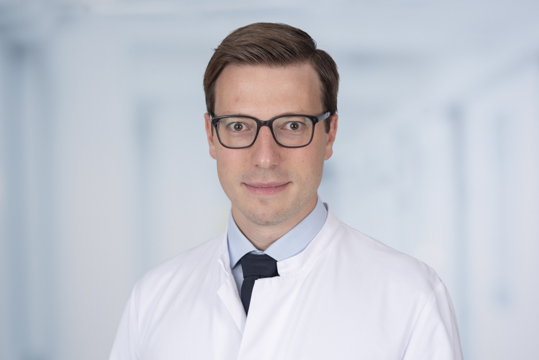
Prof. Dr. med. M. Pfau, FEBO
Our team, led by Prof. Dr. med. Maximilian Pfau, is dedicated to understanding, monitoring, and treating retinal diseases with a strong focus on inherited retinal degenerations (IRDs) and age-related macular degeneration (AMD). Together, we combine clinical expertise with advanced imaging, artificial intelligence, and innovative visual function testing to push the boundaries of personalized diagnosis and treatment for retinal diseases.
Prof. Pfau is a clinician-scientist and ophthalmologist at the University Eye Hospital Bonn. He studied medicine at Heidelberg University and completed research training at the Doheny Eye Institute (UCLA), Stanford University, and the National Eye Institute. Before returning to Bonn, he worked as Senior Consultant and Research Group Leader for IRDs at the University Hospital Basel and as a Medical Director at Hoffmann-La Roche.
Our research group works to improve diagnosis, monitoring, and treatment of retinal diseases by merging clinical insight with technological innovation. We focus on three core areas:
- Innovative visual function testing: We develop advanced, disease-specific tests—such as patient-tailored microperimetry, photoreceptor-selective perimetry, and fundus-tracked dark adaptometry—to detect subtle vision loss and better assess therapeutic benefit.
- AI-based image analysis: Using artificial intelligence and high-resolution retinal imaging, we identify new biomarkers that reflect disease severity and treatment response, accelerating clinical translation and drug development.
- Deep phenotyping of common retinal degenerative diseases and inherited retinal diseases (IRDs): Through comprehensive functional, imaging, and genetic profiling, we aim to better understand and treat conditions such as Retinitis pigmentosa or Stargardt disease.
Our goal is to enable earlier detection, more precise monitoring, and more effective, personalized therapies for patients with retinal disorders.
Employment
2025–present, Full Professor of Ophthalmology, University Hospital Bonn
2024–2025, Sr. Pr. Medical Director, Hoffmann-La Roche
2022–2025, Senior Consultant & Research Group Leader (Ophthalmology), University Hospital Basel
2020–2022, Postdoctoral Scholar (National Eye Institute), National Institutes of Health
2019–2020, Postdoctoral Scholar (Biomedical Data Science), Stanford University
2015–2019, Clinician Scientist Residency Track (Ophthalmology), University Hospital Bonn Education
Education
2021, Habilitation (Privatdozent), University of Bonn
2012–2015, Doctorate (Dr. med.), Heidelberg University
2008–2015, Medical Degree, Heidelberg University