

Nephrologische Forschung
Translationale und experimentelle Nephrologie
Arbeitsgruppe von Vietinghoff
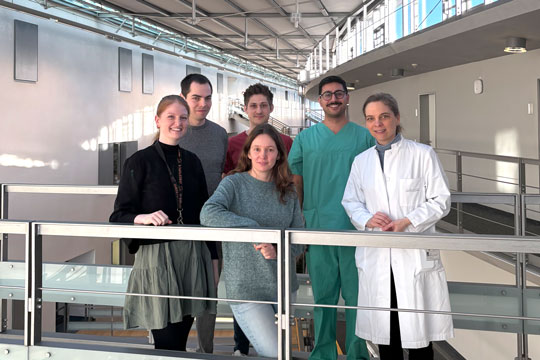
Members
Sibylle von Vietinghoff, MD
Lab manager and technician
Julia Miranda, BA
Researchers
M. Dicks, Arzt
Dr. P. Falahat
M. Förster, cand. med.
A.Goldspink, MA
P. Güls, cand. med.
F. Hartmann, cand. med.
P. Naumann, cand. med.
L. Possenriede, MA
Dr. G. Sendtner
M. Weiss, cand. med.
Research interest
 We investigate the role and regulation of leukocytes in kidney and vascular inflammation in kidney disease and kidney failure.
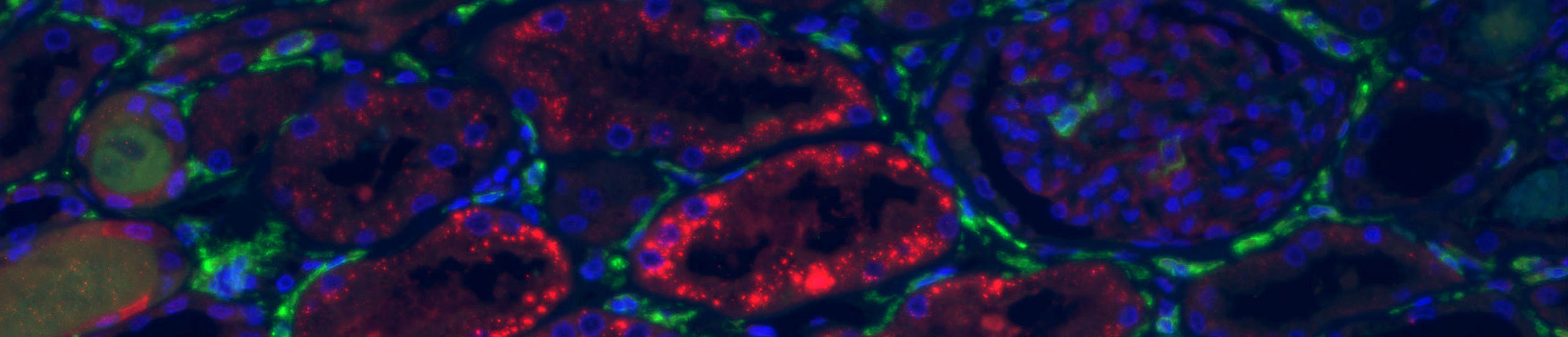
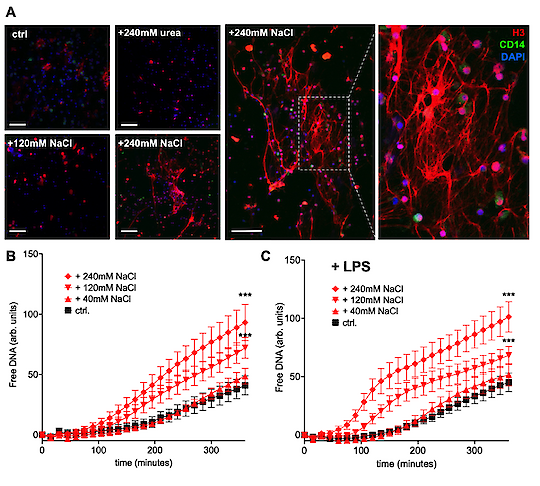
Innate leukocytes, especially neutrophilic granulocytes and monocytes and macrophages are central for kidney host response and chronic inflammation. We focus on the impact of the renal environment on leukocyte functions. Recently, this has lead to the discovery that kidney medullary NaCl (salt) concentrations can lead to programmed leukocyte cell death, namely extracellular DNA trap (NET) formation in neutrophilic granulocytes and myeloid cells (Goldspink et. al., Kidney International 2023). These NETs were beneficial in antibacterial host resposen against ascending E.coli, the most common form of bacterial kidney infection (pyelonephritis).
We also address leukocyte function in peritoneal dialysis, an important mode of renal replacement therapy. It can be a successful for years or fail due to peritoneal membrane thickening and inflammatory changes. We use our immunologic interest to better understand macrophage crosstalk with the peritoneal membrane (e.g. Helmke et al., European Journal of Immunology 2022)
Chronic kidney disease promotes atherosclerosis. We investigate inflammatory mediators of kidney-vascular crosstalk in this conditions. A recent publication elucidated how acute kidney infection promotes atherosclerotic vascular disease by recruitment of inflammatory monocytes (Possenriede et al., FASEB Journal 2026).
In summary, we aim to improve mechanistic understanding of innate inflammation in renal impairment with the goal to define specific treatment avenues.
Our work is currently supported by
Excellence Cluster Immunosensation, Deutsche Forschungsgemeinschaft and others
Sendtner GW, Miranda J, Naumann P, Weiss M, Güls P, Molitor E, Scheidt U, Schmidt A, Ludwig KU, Hilger A, Dobrindt U, Mayrhofer T, Kurts C, Wagenlehner F, Shevshuk O, von Vietinghoff S. Sodium glucose transporter 2 inhibition maintains kidney antibacterial response by decreasing complement C1q. Kidney Int. 2026 Jan 19:S0085-2538(26)00009-8. doi: 10.1016/j.kint.2026.01.003.
Possenriede L, Sendtner GW, Falahat P, Miranda J, Schmidt A, Ludwig KU, von Vietinghoff S. LDL receptor promotes urinary tract infection by α-hemolysin-producing Escherichia coli and long-term histopathologic sequelae in the kidney. Proc Natl Acad Sci U S A. 2025 Sep 23;122(38):e2520130122.
Falahat P*, Goldspink A*, Oehler L, Schmitz J, Miranda J, Gammoudi I, Bräsen JH, Klümper N, Babyak O, Kurts C, Haller H, Toma M, von Vietinghoff S. NaCl and urea modulate CD8+ T cell survival, renal accumulation and response to BK virus. JCI Insight. 2025 Aug 26:e194570. doi: 10.1172/jci.insight.194570.
Goldspink A*, Schmitz J*, Babyak O, Brauns N, Milleck J, Breloh AM, Fleig SV, Jobin K, Schwarz L, Haller H, Wagenlehner F, Bräsen JH, Kurts C, von Vietinghoff S. Kidney medullary sodium chloride concentrations induce neutrophil and monocyte extracellular DNA traps that defend against pyelonephritis in vivo. Kidney Int. 2023 Aug;104(2):279-292.. *shared first authorship
Hüsing A, Wulfmeyer V, Gaedcke S, Fleig S, Rong S, DeLuca D, Haller H, Schmitt R, von Vietinghoff S.
Myeloid CCR2 Promotes Atherosclerosis after Acute Kidney Injury. J Am Soc Nephrol. 2022 May 10:ASN.2022010048. doi: 10.1681/ASN.2022010048.Roy-Chowdhury E, Brauns N, Helmke A, Nordlohne J, Bräsen JH, Schmitz J, Volkmann J, Fleig SV, Kusche-Vihrog K, Haller H, von Vietinghoff S.
Human CD16+ monocytes promote a pro-atherosclerotic endothelial cell phenotype via CX3CR1-CX3CL1 interaction.
Cardiovascular Research 2020, Jul 27:cvaa234. doi: 10.1093/cvr/cvaa234.Helmke A*, Nordlohne J*, Balzer MS, Dong L, Rong S, Hiss M, Shushakova N, Haller H, von Vietinghoff, S.
CX3CL1-CX3CR1 interaction mediates macrophage-mesothelial crosstalk that promotes peritoneal fibrosis in vivo.
Kidney international in press 2019, https://doi.org/10.1016/j.kint.2018.12.030.Casper J*, Schmitz J*, Bräsen JH, Khalifa A, Schmidt BMW, Einecke G, Haller H, von Vietinghoff S.
Renal transplant recipients receiving loop diuretic therapy have increased urinary tract infection rate and altered medullary macrophage polarization marker expression.Kidney International 2018 Nov;94(5):993-1001.
Forschungsförderung


AG Klinische Prädiktion
Arbeitsgruppe Schwab
Mitglieder
Das Zentrum für Nephrologie, Dialyse, Transplantationen, Bauchfelldialyse, Fettstoffwechsel, Lipidambulanz, Studienambulanz in Bonn
PD Dr. Sebastian Schwab, Nephrologe, Oberarzt
Dr. Uta Scheidt
Michel Brodesser (Med. Doktorand)
Philine Grashoff (Med. Doktorandin)
Janina Zumhoff (Med. Doktorandin)
Biomarker zur Vorhersage von Nierenfunktion und kardiovaskulären Komplikationen
Die Einschätzung der Nierenfunktion erfolgt überwiegend über die Bestimmung von Serum-Kreatinin und Serum-Cystatin C als Grundlage für die Berechnung der glomerulären Filtrationsrate (eGFR), aber auch für die Einteilung des Schweregrades, und für die Abschätzung der Prognose der Nierenkrankheit. Kreatinin, Cystatin C und die Albuminurie, die am häufigsten verwendeten Messwerte zur Beurteilung der Nierenfunktion respektive des funktionellen Nierenschadens, spiegeln in erster Linie die Integrität der Glomeruli wider und erfassen als „glomerulozentrische“ Betrachtung keine Tubulusfunktionen wie die Reabsorption gefilterter Moleküle, die Abwehr von Infektionen, die Proteinsynthese sowie Sekretion und die Regulation der Säure-Basen-Homöostase. Auch bei der akuten Nierenfunktionsverschlechterung sind die Eckpfeiler der Diagnostik Veränderungen des Serumkreatinins sowie der Urinausscheidung und damit unspezifisch.
Die Einschätzung der residualen Nierenfunktion bei Dialysepatienten ist im Vergleich zu chronischen, nicht-dialysepflichtigen Patienten sehr viel schwieriger. Die Restnierenfunktion hat besonders bei Hämodialysepatienten eine große Bedeutung, vor allem in Bezug auf kardiovaskuläre Morbidität und Mortalität, zumal kardiovaskuläre Erkrankungen weiterhin die häufigste Todesursache bei Nierentransplantationsempfängern sind.
Zusammenfassend befasst sich die Arbeitsgruppe mit der diagnostischen Wertigkeit von verschiedenen glomerulären und tubulären Biomarkern sowie der Prädiktion eines fortschreitenden Nierenfunktionsverlustes und kardiovaskuläre Ereignisse.
Peritoneal and renal DKK3 clearance in peritoneal dialysis.
Ehleiter H, Miranda J, Boes D, Scheidt U, von Vietinghoff S, Schwab S. BMC Nephrol. 2024 Aug 23,25(1):268
Recent Insights in Noninvasive Diagnostic for the Assessment of Kidney and Cardiovascular Outcome in Kidney Transplant Recipients.
Falahat P, Scheidt U, Pörner D, Schwab S. J Clin Med. 2024 Jun 27;13(13):3778. doi: 10.3390/jcm13133778. PMID: 38999343 Free PMC article. Review.
NT-proBNP as predictor of major cardiac events after renal transplantation in patients with preserved left ventricular ejection fraction.
Schwab S, Pörner D, Kleine CE, Werberich R, Werberich L, Reinhard S, Bös D, Strassburg CP, von Vietinghoff S, Lutz P, Woitas RP. BMC Nephrol. 2023 Feb 11;24(1):32. doi: 10.1186/s12882-023-03082-9.
Pre-transplant serum Beta Trace Protein indicates risk for post-transplant major cardiac adverse events.
Schwab S, Pörner D, Kleine CE, Werberich R, Werberich L, Reinhard S, Bös D, Strassburg CP, von Vietinghoff S, Lutz P, Woitas RP. Nephrology (Carlton). 2023 Jan;28(1):51-59. doi: 10.1111/nep.14131. Epub 2022 Nov 21.
Beta-trace protein as a potential biomarker of residual renal function in patients undergoing peritoneal dialysis.
Schwab S, Kleine CE, Bös D, Bohmann S, Strassburg CP, Lutz P, Woitas RP. BMC Nephrol. 2021 Mar 11;22(1):87. doi: 10.1186/s12882-021-02287-0. PMID: 33706697